The speed of innovation
-
 Tom Parson
When we hear about "the pace of innovation", or that someone is "buzzing" with new ideas, it conjures up images of high speed, or constant movement. But does innovation really happen quickly?
We have all experienced innovations that came along just at the right time, and seemingly happened overnight - like Zoom video calling, QR codes or AI.
It does feel like innovation and speed go hand in hand - surely innovation requires us to work at pace - keeping up with ever-changing behaviours and technologies, to stay one step ahead? "Move fast and break things" being Zuckerberg's infamous motto for Facebook's early days.
Let's see if speed really is a requirement for effective innovation.
Overnight innovations
If we dig deeper into those examples above, we see how long they really took to materialise:
- Zoom originally launched way back in 2011.
- QR codes were first invented in 1994 (!) at a subsidiary of Toyota, where they used them to track automobile parts.
- And OpenAI's GPT series began in 2018, with machine learning more broadly beginning over 70 years ago! At the University of Manchester no less 😎
Maybe it took longer than it seems for the innovations we're all familiar with to become such a big part of our lives.
And research suggests that a slow and incremental rate of innovation yields a sustainable competitive edge, something that the likes of Zoom and OpenAI certainly have.
So let's just all slow down, take things as they come, and relax.
Easy, right?
Why is it so difficult to slow down?
For me, buried deep down, I have a fear of slowing down.
There is, of course, a business owner element to this - if I'm not busy then I'm not earning money. But it goes deeper than that.
If I slow down, I'm confronted with a sort of paralysis. Despite having idealised visions of working from my serene forest cabin, spending the day sipping tea and clocking in max 3 hours work per day, part of me doesn't know how to live if I actually find myself with this kind of freedom.
I get scared that I'm not making best use of my time which is, I suppose, a fear of my own mortality. I get a kind of pre-emptive regret - like I'm already lying on my deathbed lamenting all the days I wasted "relaxing" when I could have been doing things more worthwhile - things I'd later be proud of.
But, as my therapist patiently and repeatedly helps me realise, it's more likely that I'll be on my deathbed regretful of all the days I spent anxiously worrying about being on my deathbed.
Go fast at all costs
In our modern society we have been trained to value fast results, and this perspective is only being amplified by the use of AI as a "productivity enhancer."
A magical way that we can do everything we did previously, in half the time.
I've experienced this first hand and it has genuinely freed up time for me to work on more meaningful things, which has been liberating.
The risk though, is that rather than using the new-found freedom for something that truly adds value and richness to our lives, we just do more of the same types of work and become busy fools.
Time pressure and creativity
There is plenty of research on the complex effect of time pressure on innovation - it's not as simple as 'more time equals better results' (I know I've certainly had to "get creative" when running out of time).
But one thing does seem to jump out - time pressure can make us more inclined to seek closure and completion and cause us to rely more on guidelines and best practice.
So if we're trying to do some "what if?" thinking, and come up with original creative ideas, time pressure is likely to be counterproductive.
Because not everything is about doing things as fast as possible, despite what tech platforms and social media will have you believe.
A new way of thinking about work
After all, great ideas often come during slower times away from our desks. We often don't consider this to be work, simply because it's happening out on a walk, or while chopping carrots, or as we're falling asleep.
But it's no coincidence that these creative ideas seem to happen when we're not really trying, or while our brain is idle.
Our brain is engaged in something called diffuse thinking - where it's allowed to solve problems by relaxing and seeing new connections in a natural way.
Diffuse thinking is what's happening when ideas are "percolating" or "incubating" - and research has shown that our subconscious is actively working on ideas during this time even if we're not consciously aware of it.
Without getting into the weeds of what is and isn't "work", it's undeniable that this kind of time often yields new perspectives, new connections, and can lead to our best ideas.
Benefits of innovating slowly
From my experience with clients:
- Slowing down helps to notice things in more detail and see things that others miss.
- Letting ideas incubate helps to understand their implications - we can "try them on" mentally, see how they feel, and anticipate unforeseen consequences.
- Going slower between each stage creates space to sense check and get other perspectives.
- Slowing down helps you avoid hype cycles and fads - if your idea is still exciting after some time, it's more likely to be sustainable.
Diffuse thinking with clients
When I first start working with clients, they're often expecting a focussed or process-led approach from me. They may expect a proposal for a workshop or paid session.
That does come in time, but that isn't really where our work together begins.
Our work already started during our first chat over a coffee. This is time that allows us to share our experiences, find where our perspectives overlap, and discuss thoughts and observations. Important stuff!
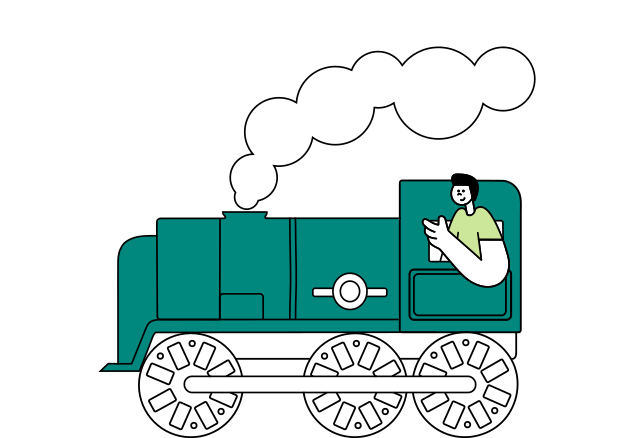
During this chat we're each boarding a train of thought - settling into our seat and arranging our things around us. So that, at the point where we shake hands and part ways, the train leaves the station and something has begun.
In the following days and weeks, the train is meandering around and coming in and out of view. Disappearing behind hills and popping back into our heads in the shower or while commuting to work.
Neither of us knows where it's going, but it's showing us some interesting sights along the way.
Setting aside speed
By encouraging this kind of slow cultivation of ideas from the get-go, I encourage clients to set aside a process-driven, arrow-to-the-bullseye approach to problem solving, and trust their diffuse thinking to work on things.
So that by the time we meet again, we can compare notes. What ideas have you been thinking about? Where did your train go and what did you discover along the way? Then, we get to work bringing those ideas out and starting to develop them in a more focussed way.
The clients of mine who have gone on to achieve meaningful, sustainable innovation have all adopted this combination of diffuse thinking and focussed problem solving in their innovation process.
Great things do take time, but only some of that time needs to be spent hard at work. The rest, we can leave to our diffuse thinking.
If you'd like to put these thoughts into action, I’ve put together a 3-step guide on making more time for diffuse thinking:
 Tom Parson