Step away to move forward
-
 Tom Parson

Leverage diffuse thinking to help you solve sticky problems and come up with better ideas.
This play works when:
- You feel you're not living up to your own expectations
- You're not doing as well as others in your space
- You just can't seem to keep on top of everything
How to Play
In The Speed of Innovation, I explain how many of the overnight success innovations we're all familiar with (Zoom, QR codes, AI) have actually been years in the making.
I outline how speed isn't necessary for innovation, and in fact, better results are possible if we slow down and innovate slowly.
I know, I know, sometimes you just have a bunch of stuff to do and need to get it done. That's fair and valid for some kinds of work.
But all too often we let this way of thinking dominate all of our work, and there are some types of work - like the value-adding ideas-generating problem-solving time - which definitely do not necessarily work better at speed.
This play gives you a practical framework to make time for this kind of slower thinking.
Step 1
If you've ever had a great idea while out on a walk, or nodding off to sleep, or while gazing out the window - you've experienced diffuse thinking.
Diffuse thinking is the subconscious process that's happening when you're not consciously working on a problem, but your brain is beavering away behind the scenes.
The first step in this play is to read the short article below on diffuse thinking, to learn a little about how it works (3 min read):
 Scotch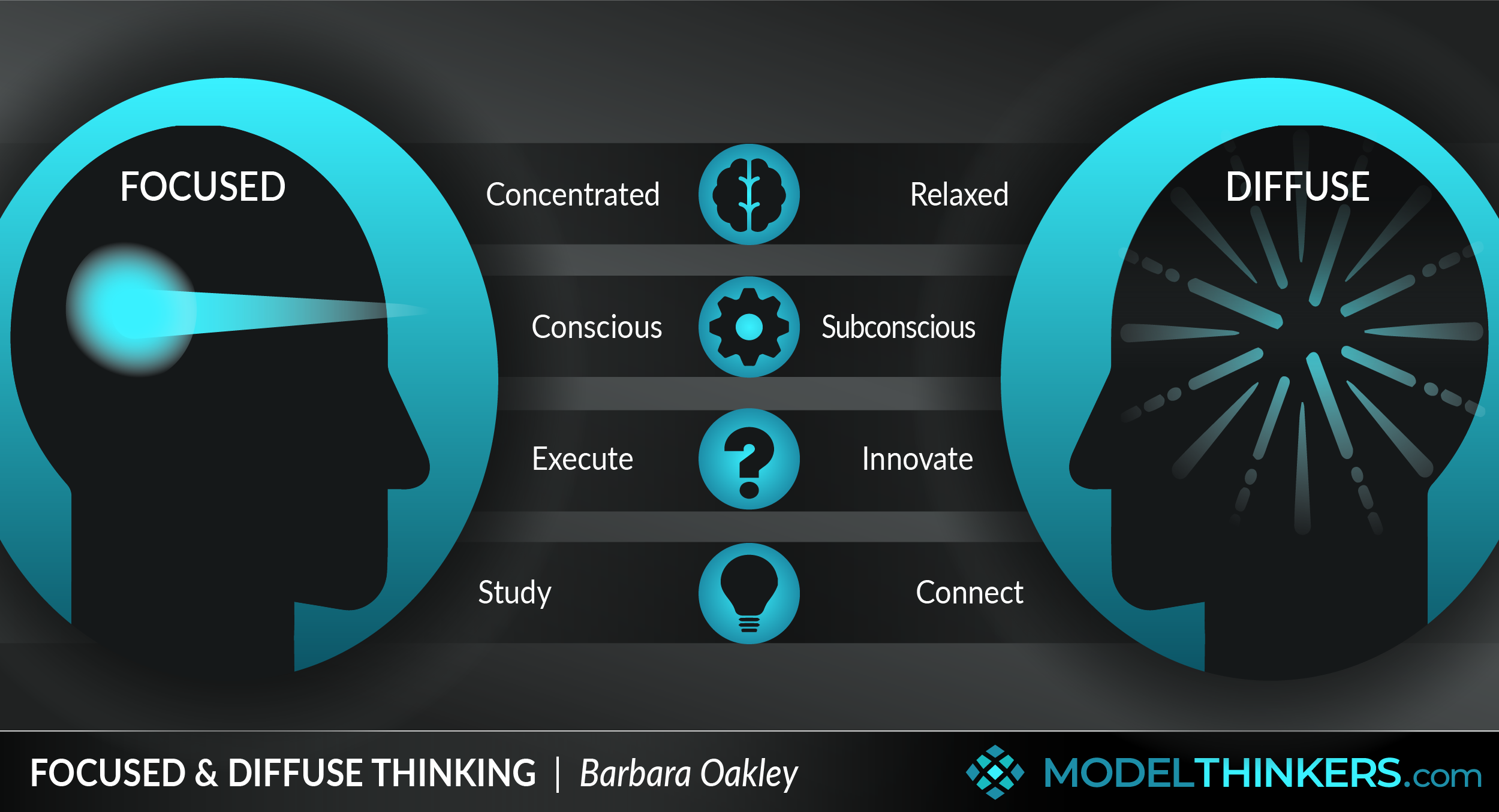
Step 2
Next, you'll need to identify how you can make time for this kind of diffuse thinking.
This might seem a little like trying to make yourself fall asleep, or trying not to think of a pink elephant.
But this play is simply about creating a space, it's not about trying to get results.
In order to decide what this looks like for you, think about the last time you let your thoughts wander.
For me, here are some of the times when I experience this:
- Out for a walk
- In the shower
- At the gym
- About to fall asleep
- Swimming
- Cooking
- Driving
When was the last time you experienced your thoughts wandering or lost track of time? What were you doing?
Step 3
Once you've identified at least one of these, the final step is all about making time for this.
Naturally, this is the most difficult step!
And, not to make it even harder, but I have two main considerations for this stage.
- Try and create space for this time during a part of the day that feels right, rather than one that simply fits into your calendar. It might feel best to go for a walk on a Saturday morning, or it might be slap-bang in the middle of your work day at 11am, or after the post-lunch slump at 2pm when you need to get some distance from your desk.
- Make time for this activity intentionally. Rather than "well I'm going to be driving to the shops on Saturday morning, so I'll do my diffuse thinking then" this is about creating extra opportunities on top of your existing habits.
This can be something you plan, or it can be something spontaneous, it's up to you.
Try this in the next week or so, and see how you feel afterwards.
It's okay to make time for this
I understand it might feel like a massive luxury to do this (I mean, it is) but it's okay - you have my permission.
As business owners if we can't take an hour to clear our heads when we need it most, then what are we doing?
Work comes in all shapes and sizes, and not all of our work has to be done at a computer.
While making time for diffuse thinking, you may well experience moments of "Oh - I should write that down" which is great! But, if this doesn't happen immediately, don't lose faith.
The more you can make time for this regularly, the more space you are giving your subconscious to work on problems for you.
This will lead to better decisions, more perspective and new ideas - it can just take time.