How to prioritise with a weighted matrix
-
 Tom Parson
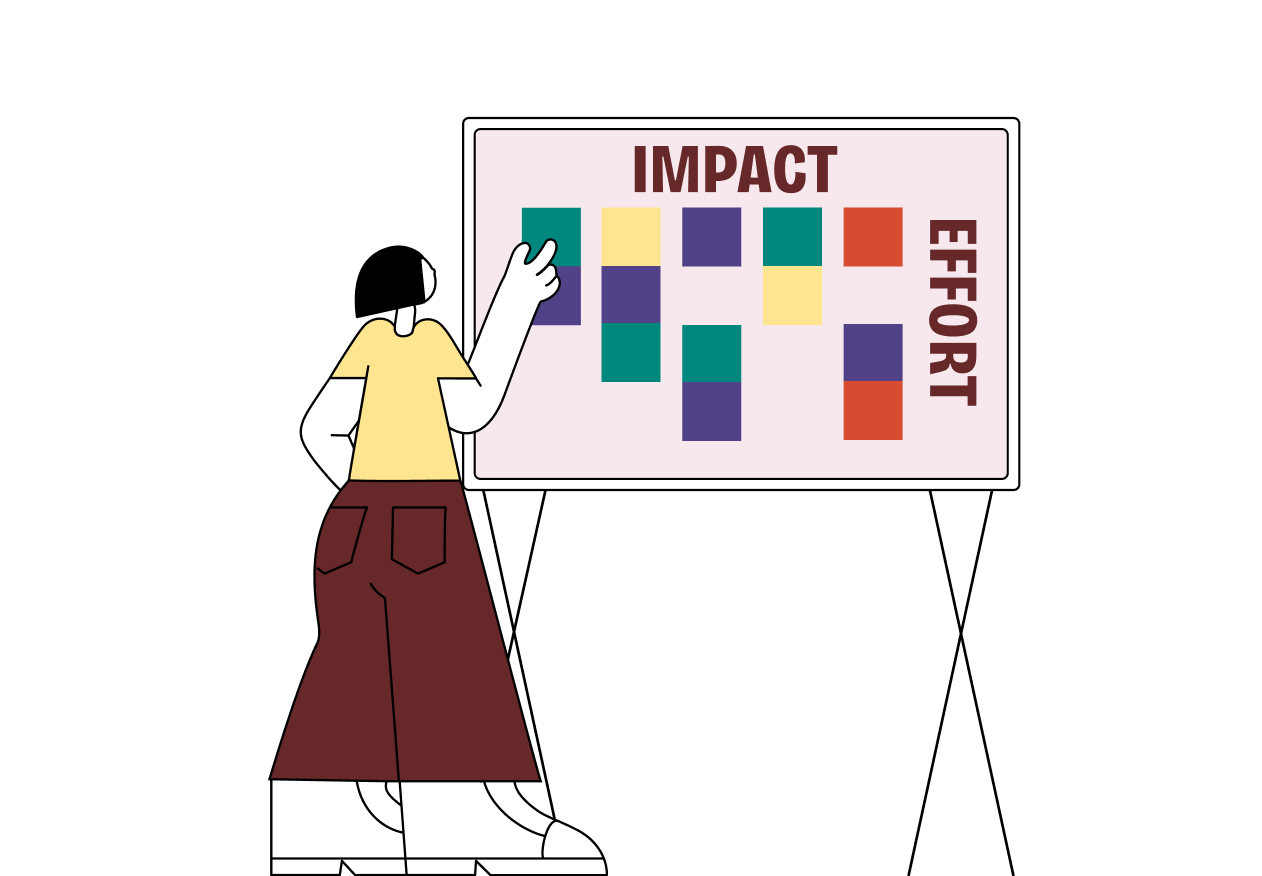
When faced with new ideas and impending change, how do you decide where to start?
This play works when:
- You have multiple ways of moving forward and you don't know where to start.
- You need a more objective way of prioritising tasks.
- You're constantly second guessing how you're spending your time.
How to Play
A matrix sounds like a complex idea, but it's literally just a table with rows and columns, used to organise things.
A weighted matrix uses a ranking system whereby you take a list of possibilities, score them out of 5 in different areas, and use this data to visually organise and prioritise.
To get started, you'll need to get the list of things you want to organise. This could be a list of potential innovation ideas, or simply a to do list. It might be the output from SCAMPER, Devil's AI-dvocate, or Ikig-AI.
Basically, any list where you look at it and thing "ok, now what? where do I start?"
Step 1
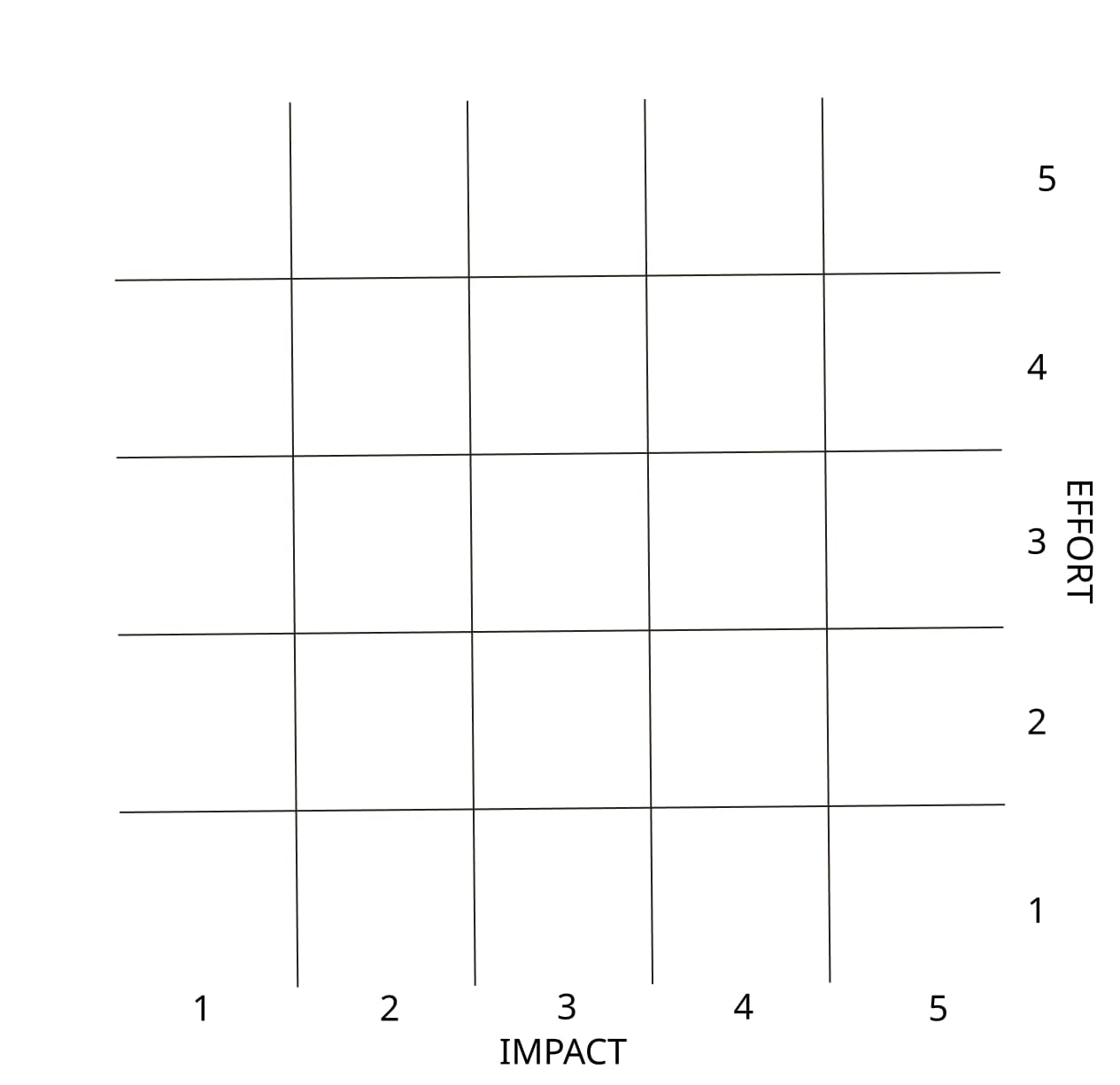
First, you need to create your matrix. Draw a 5x5 box like the one below. You can do this on a piece of paper, on a white board, or digitally.

Now, pick 2 different factors you're going to use to score everything on the list.
A good place to start is Impact and Effort, where you'd take each item on the list and give it a score out of 5 both for how impactful it could be when finished, and how much effort it will take.
But you can use other factors that are relevant to your situation. Here's a complete list to consider:
- Impact - what is the potential value this could create?
- Effort - how difficult will this be to implement?
- Reach - what is the potential to attract new customers?
- Confidence - how confident are you with this idea?
- Ease of use - how easy to use will this be for customers?
- Timeliness - how important is it to do this now?
Once you've decided on 2 of these, write one along the bottom and another up the side, adding numbers like so:
Step 2
Finally, take the things you need to prioritise and, one by one, place them on the matrix in the right place.
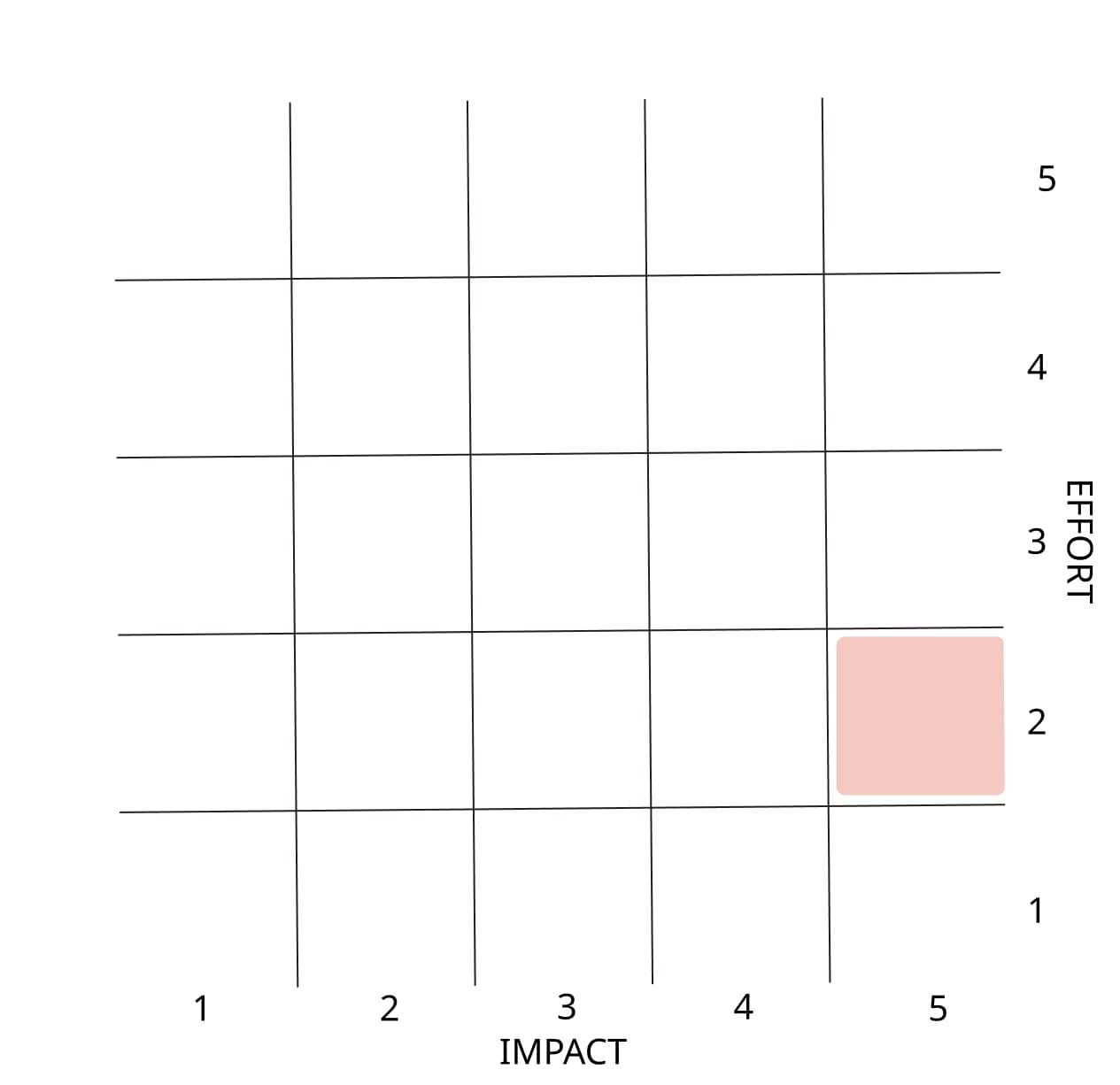
Let's say in our example above, we are evaluating something from our list and we decide:
- It has the potential to make a big impact, so we give an Impact score of 5 out of 5 and place it in the column on the far right.
- It is going to take relatively low effort, so we give an Effort score of 2 out of 5, place it in the second row from the bottom.
So, we put it here:
Step 3
By the end, your matrix will have a bunch of ideas distributed across it. At this stage, ask yourself 3 questions:
- What 5 things should I do in the short term (e.g. this week)?
- What 3 should I plan to do next (e.g. this month)?
- Which 1 thing should I plan for the long term (e.g. next 3 months)?
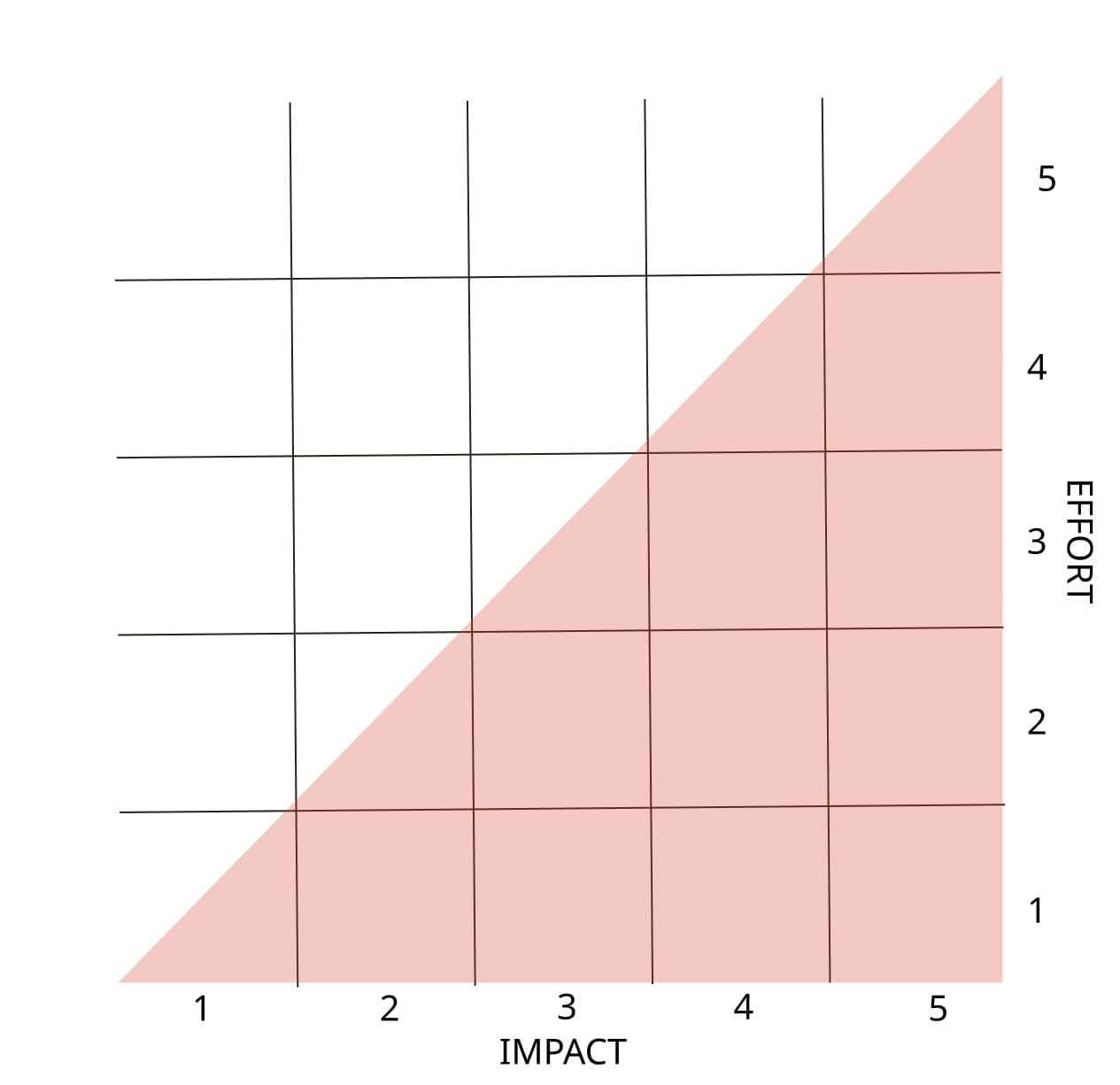
In our Impact vs Effort matrix, we might:
- Pick things in the bottom area to focus on in the short term, preferably closer to the right-hand side (i.e. low effort and medium-high impact).
- Pick things across the middle, closer to the right, to do next (medium effort and high impact).
- Pick something that is far to the right (high impact) with manageably high effort.
In essence, we're focussing on this area of our matrix (i.e. we don't want things that are high effort and low impact):
Why it Works
Deciding what to do next from a big list is intimidating and complex.
Breaking this down into a series of smaller decisions (how much effort is this out of 5?) helps us to begin to tackle things in a more manageable way.
Not only that, but providing some kind of objective way to track your thinking and decision making means you can remind yourself (and others) of your motivation later. Making decisions based on logic, not gut feel, helps to bring people along for the journey.
Use it to
- Focus your time on important tasks
- Add structure to your thinking
- Embrace both short-term quick wins and long term strategic impact